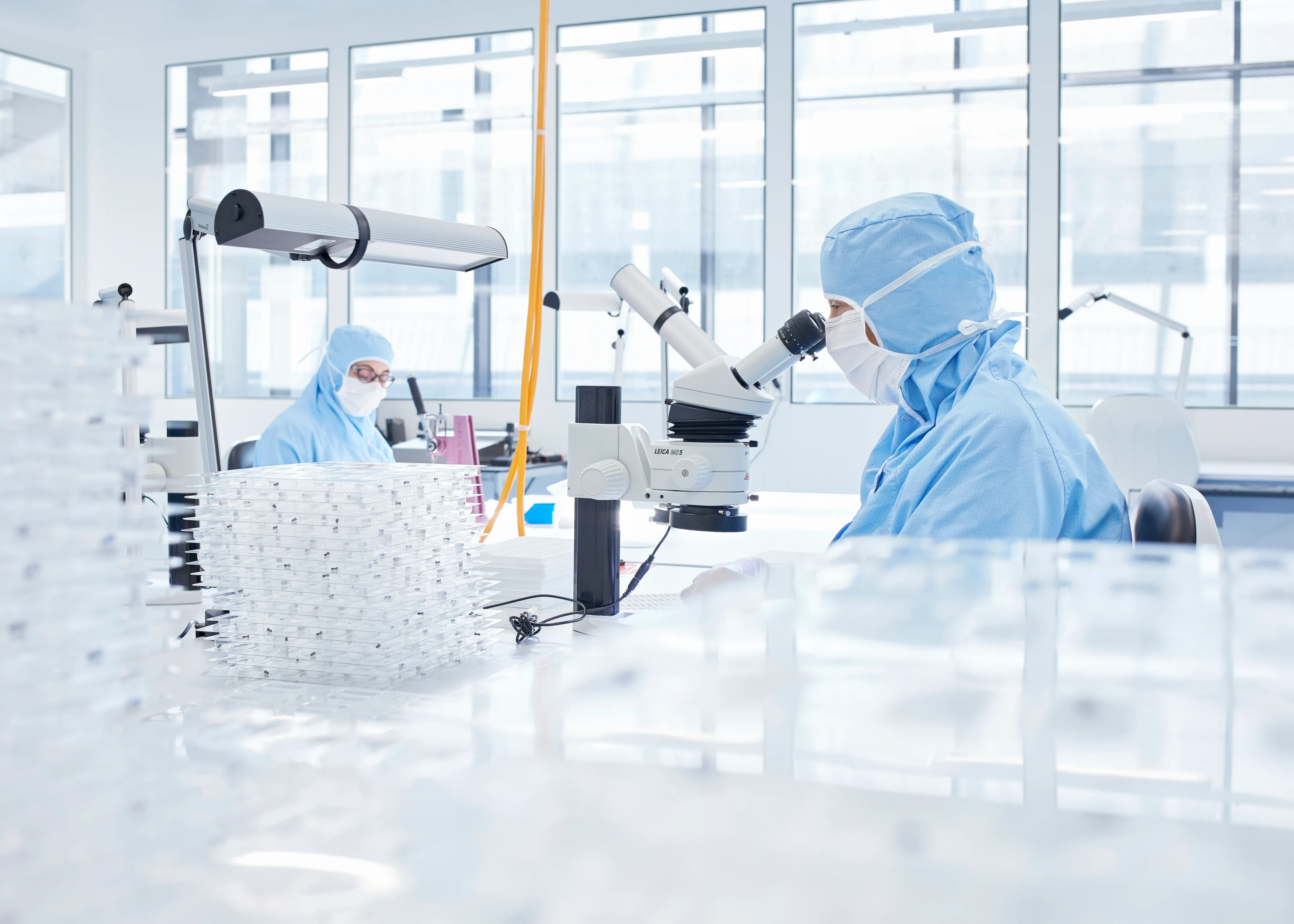
An ISO 7 cleanroom is a room whose air may hold no more than 352,000 particles of 0.5 µm or larger per cubic meter, under ISO 14644-1. An ISO 8 cleanroom may hold ten times as many.
For a device maker sourcing parts that a supplier cleans, assembles or packages in a cleanroom, the class number is where the questions start. A class is stated for an occupancy state, shown by a test and held by the way the room is run, with monitoring as the evidence that it still holds. Each of these points can be checked when you qualify a supplier.
What ISO 7 and ISO 8 mean under ISO 14644-1
ISO 14644-1 classifies a cleanroom by the concentration of airborne particles. Its current edition, ISO 14644-1:2015, sets the limits per cubic meter of air, and the limits are cumulative: each one counts every particle at or above that size. For ISO 7 and ISO 8, limits apply at 0.5, 1 and 5 µm. At 0.1, 0.2 and 0.3 µm the standard sets no limit for these two classes, because the particle concentrations would be very high. At each size that applies, the ISO 8 limit is ten times the ISO 7 limit, the same step that separates any two adjacent classes.
| Particle size | ISO 7 | ISO 8 |
|---|---|---|
| ≥0.1, ≥0.2 and ≥0.3 µm | Not specified | Not specified |
| ≥0.5 µm | 352,000 | 3,520,000 |
| ≥1 µm | 83,200 | 832,000 |
| ≥5 µm | 2,930 | 29,300 |
| Legacy FED-STD-209E name (per cubic foot, at ≥0.5 µm) | Class 10,000 | Class 100,000 |
Limits are cumulative: each one counts all particles at or above that size. ISO 14644-1 sets no limit at 0.1, 0.2 or 0.3 µm for ISO 7 and ISO 8. FED-STD-209E was canceled in November 2001 and is shown for reference only.
Legacy US class names come from FED-STD-209E, which counted particles per cubic foot of air. That standard was canceled in November 2001 and superseded by ISO 14644-1 and ISO 14644-2. At 0.5 µm, its Class 10,000 corresponds to ISO 7 and its Class 100,000 to ISO 8.
Every class is defined for one or more of three occupancy states. As-built is the finished room with its services connected and working, and no equipment, materials or personnel inside. At-rest adds the equipment, installed and operating as agreed, still without personnel. Operational is the room working as specified, with the specified number of personnel present. A complete designation names the class, the occupancy state and the particle sizes considered. People and processes release particles, so a room shown to meet ISO 7 at rest has not yet been shown to meet it in operation.
ISO 7 cleanroom or ISO 8: where each class typically sits
ISO 14644-1 defines the classes but does not say which manufacturing step needs which. Neither do the rules device makers work under. ISO 13485:2016 asks for a documented, controlled work environment and names no cleanroom class. The FDA’s Quality Management System Regulation (21 CFR Part 820), in force since February 2, 2026, incorporates ISO 13485:2016 by reference, and its own text names no class either.
Advice published by suppliers gives a starting point rather than a rule. It puts most terminally sterilized devices in ISO 7 or ISO 8, and many assembly programs end up in that range. For aseptic assembly, it expects ISO 5 at the critical zone, inside an ISO 7 or ISO 8 background. The same sources disagree on whether assembly belongs in ISO 7 or ISO 8, and some note that not every part or step needs a cleanroom. The class follows the device’s risk assessment, including bioburden and how exposed the critical surfaces are, applied to each part and step.
Running every step in the tighter class has a cost. At ISO 8, gowning can be a coat, hairnet and gloves, while a tighter class can add a full coverall, hood, boot covers and a formal donning sequence. A room classified tighter than its use requires also adds testing and monitoring cost.
What keeps an ISO 7 or ISO 8 cleanroom in its class
A room reaches its class through design and keeps it through operation. ISO 14644-1 sets no air-change rate. The design standards, ISO 14644-4:2022 (design, construction and start-up) and ISO 14644-16:2019 (energy efficiency), size the supply airflow by calculation instead: from the contamination sources such as people and process, the target concentration and the ventilation effectiveness. Operation falls under ISO 14644-5:2025, which covers procedures, training, gowning, the transfer of materials and equipment, cleaning and maintenance.
Compliance with a class is shown by testing, with the methods set out in ISO 14644-3:2019. At each sampling location, the measured concentration, averaged where several samples are taken, must not exceed the limit. The results go into a test report that records, among other items, the testing organization, the test date and the standard with its year. ISO 14644-2:2015 asks for this classification test once a year by default. The interval can be extended on the basis of a risk assessment, the extent of the monitoring and data that stay consistently within the plan’s limits.
Between tests, monitoring provides the evidence that the room still performs. ISO 14644-2 asks for a monitoring plan based on a risk assessment of the room’s use, with particle monitoring that may be continuous, sequential or periodic.
“Certified cleanroom” is a common phrase, but ISO 14644-1 classifies a room. ISO itself issues no certificates; certification, as for an ISO 13485 quality management system, comes from independent certification bodies. For a cleanroom, the document to ask for is the classification test report.
A particle class does not cover microorganisms. ISO 14644-1 counts particles without telling viable from non-viable ones, and ISO 14644-2 leaves microbial monitoring out of its scope. For products that will be terminally sterilized, AAMI TIR52:2026 gives voluntary guidance on monitoring viable particles in the manufacturing environment. The cleanliness of the part itself is a separate requirement, set for the product rather than the room.
Questions to ask a supplier about its cleanrooms
Before you rely on a supplier’s cleanroom class, ask:
- Which class, in which occupancy state, and at which particle sizes?
- Which of your parts and process steps run in which class, and which run outside a cleanroom?
- When was each room last classified, by whom, and can you see the test report?
- How is each room monitored between classifications, and what happens when a result exceeds the plan’s limits?
- Which gowning, training and cleaning programs apply in the rooms?
- If your device needs microbial control, how is it handled and monitored, separately from the particle class?
Then write the answers into your specification, together with the cleanliness requirements for the parts themselves: particle or microbial limits, bioburden or endotoxin thresholds, and packaging and handling needs.
ISO 7 and ISO 8 cleanrooms at CMSA
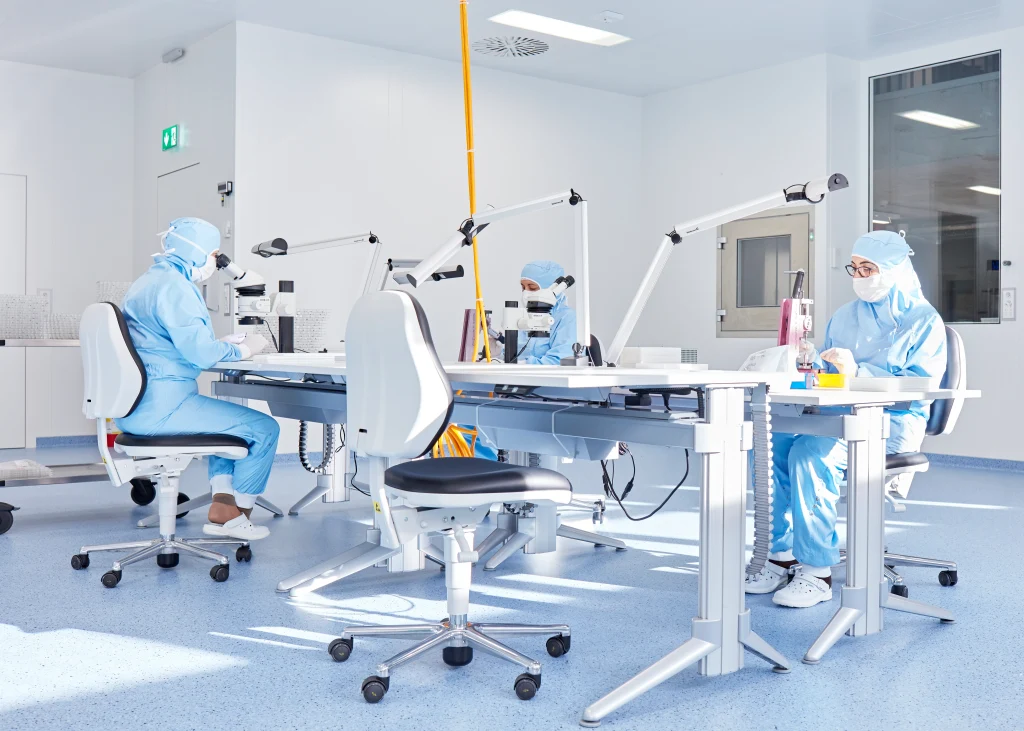
We run ISO 7 and ISO 8 cleanrooms for contamination-controlled assembly and packaging of MedTech parts. Cleanroom assembly is available for critical assemblies, and final assembly can run in these cleanrooms. We perform packaging in controlled environments, our cleanrooms included, and handle components that require microbiological control or a specific cleanliness level.
In our ISO 7 cleanrooms, we inspect and assemble parts and pack them in rigid or flexible packaging, including parts with microbiological requirements; our ISO 8 cleanrooms handle the same steps for parts without such requirements. Labeling takes place outside the cleanrooms. Our cleanrooms are classified to ISO 14644-1 in the operational state, with particles measured at 0.5 and 5 µm, and each room is reclassified once a year. Customers can review the classification test reports on request. Where parts need microbiological control, we monitor airborne and surface microorganisms, and cleaned parts are tested for bioburden, cytotoxicity and endotoxins.
Our clinical-grade cleaning is validated and traceable. Cleaning runs in controlled environments, not always inside a cleanroom: a cleaning machine outside the cleanrooms can clean parts and place them in their packaging. Our cleaning processes include alcohol-based degreasing, ultrasonic multi-stage cleaning, passivation and cleanroom handling, and our cleaning levels include particle and film removal (Level 3) and microbiological control for clinical applications (Level 4).
Our MedTech work runs under an ISO 13485 quality management system. We prepare parts for what comes next, whether assembly, sterilization or end use. The device maker remains responsible for validating and sterilizing the finished device, and for its biological evaluation, as our article on biocompatible materials explains.
Planning a device with parts that need cleaning, cleanroom assembly or packaging? Talk to our MedTech team while the specification is still open.
Meet us at COMPAMED in Düsseldorf
Want to discuss cleaning, cleanroom assembly or packaging for your next device in person? Our team will be at COMPAMED 2026 at Messe Düsseldorf, November 16-19, 2026, held alongside MEDICA.
Find us in Hall 8a, booth K16 (hall plan).
Share